Latest

The Power of All-Girls Education

Single-sex education prioritises young women and girls, allowing them to take the centre stage in their education with confidence and pride, something co-educational schools often can’t support.
Nationally, schoolgirls are being left behind, with lessening rates of engagement, proportionally low participation in STEM subjects and physical education and poor mental wellbeing. Time spent outdoors has been replaced with screentime, and social media dominates social development.
Although historically girls have been less likely to be absent from school than boys, the gap has rapidly closed in recent years, with a 257% increase in severe absenteeism in girls from 2017/18 to 2023/24, evidence of how challenging the post-pandemic landscape has been for schoolgirls.
Putting schoolgirls first has a proven effect, from increased engagement in the classroom and improved results to greater participation in sports and eliminating the “confidence gap” between school aged boys and girls that is so prevalent in co-ed schools.

Research1 in developmental neuroscience reveals that boys and girls develop readiness and self-regulation at different stages, something which has a direct impact on behaviour in the classroom and learning outcomes. A 20182 study showed that the “confidence gap” is eliminated in single-sex environments, with girls developing confidence and leadership skills at approximately the same rate as their male peers. What’s more, without stereotypes informing subject choices, girls are shown to be far more likely to pursue careers in STEM3.
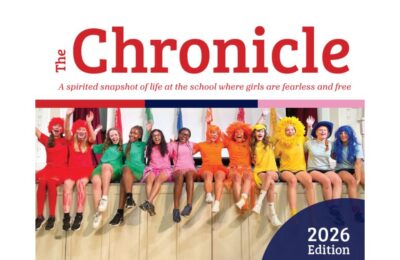
Girls’ education is about creating an environment designed specifically for the social and academic development of girls, where they can learn to trust their own abilities, work collaboratively and lead others, with undivided attention from educators. We see the effects of single sex education in our girls every day, in their confidence, energy and ambition.
Girls at single-sex schools pursue subjects based on personal choice, not stereotype or expectation. Research by the Girls’ Schools Association reveals that pupils in all-girls’ sixth forms are significantly more likely to engage in STEM subjects, being 2.9 times more likely to take Further Mathematics, 2.3 times more likely to take Physics at A-level and 79% more likely to take Computing Science, as well as other STEM subjects.

The research also highlighted that girls from all-girls’ sixth forms are more likely to pursue a degree in mathematics or science at university compared to the national average for girls. It is clear that single-sex education plays a vital role in encouraging young women and girls into STEM, where they are dramatically underrepresented.
Scotland needs 13,000 new digital professionals yearly due to its rapidly developing tech sector, which has huge potential economic benefit, but produces only 5,000, with women making up only 23% of that number. Moreover, women make up only 22% of the AI workforce, meaning they are being left out of the most influential, high-paying jobs of the future, which has the resulting risk of perpetuating the already prevalent gender bias in generative AI. Closing the gender gap in tech is increasingly vital for the Scottish economy, but also for the development of inclusive technologies.

One in six girls’ school alumnae have worked in a finance related role, while in the UK only 3% of working women currently work in the industry. Single-sex female education is helping to open doors for young women that have been closed for far too long.
Pupils in girls’ schools also have higher levels of participation in sports and physical education, participating around 25% more than the national average. Nationally, participation in physical education declines around puberty, but recent studies have revealed that girls start being less active than boys around age seven, and, worryingly, play outside less than boys as early as age two. Currently, only 12% of Scottish girls meet activity standards by age 15 due to the national gender play gap.

Barriers to young girls playing sport are numerous, with boys’ sport teams prioritised over girls’ in school playing fields; gender stereotypes about the types of sports girls play; discomfort with PE kit, and more. In co-ed environments, girls are literally pushed to the periphery when it comes to sports, with the unspoken message being that “girls watch it, boys play it”.
We can see the evidence that girls-only physical education works through the 100% of St George’s pupils still taking part in PE and sports clubs at 18, a statistic which dramatically bucks the national trend. Our girls are active from nursery through to sixth form, and we see the benefits both on and off the playing field.
Taking part in sport is vital to social development and wellbeing: the combination of getting outside and away from screens and working as a team is infinitely beneficial. Surveys have linked girls playing sports in their youth to future career success; both competitive and non-competitive sport develop leadership and communication skills as well as resilience and confidence in schoolgirls.
At St George’s we put girls first in every aspect of their education. Our teachers tailor techniques and content to the needs and preferences of our pupils, with female role models highlighted from P1 through to S6. Studies show that girls can start to lose faith in their own abilities as early as age six, believing themselves to be less inherently “brilliant” or “talented” than their male peers, likely due to exposure to media, experiences with teachers and interactions with other children. Girls at single-sex schools see representation of brilliant women every day, and as a result recognise their own potential, and their own brilliance.